

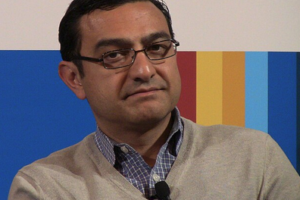
Vic Gundotra, former senior vice president of Google and a Catholic convert, shared about how AI, the Bible, and his faith at a recent Catholic business leadership conference.
At a recent Legatus Summit, a Catholic business leadership conference in California that ran from Jan. 29-31, 2026, Gundotra shared practical ways to use AI for faith while also highlighting potential pitfalls of the tool.
Vic Gundotra’s Path to the Catholic Faith
Gundotra’s path to Catholicism was winding. Raised as a Jehovah’s Witness, he became highly involved in that church, even becoming an elder. He eventually began to have doubts, but the religion’s strict rules banned any questioning of doctrine, under pain of “disfellowship.” 
“It’s a very dangerous thing as a Jehovah’s Witness. It was quite a struggle to be able to leave the faith and get out,” he told Legatus’ Stephen Henley in a podcast shared alongside the summit.
Losing everything, the cost of questioning
When he told his wife he had serious concerns about their religion, he remembers that “she started crying and said, ‘I can’t do this. I can’t lose my friends, my family.’”
“You lose everything,” Gundorta explained. “The consequence as a Jehovah’s Witness, of doing deep research and viewing critical thinking on your doctrines, which very few Jehovah’s Witnesses ever do, is disfellowshipping. It’s a profound ax that hangs over your head.”
Eventually he and his wife decided to leave, and Gundotra became an atheist. Over the years, when he was at what he describes as his lowest point, Gundotra began to find his way to Catholicism through the mentorship of a colleague he once worked with at Microsoft.
The 2 am call that led to a long journey of discovery… “Listen to Clement”
It was 2 in the morning on the East Coast when Gundotra texted this friend that he needed to talk. His friend responded immediately. When Gundotra asked why he was awake, his friend told him: “I’ve got adoration duty.”
From there followed a long process of discovering the early Church fathers, studying the faith, and ultimately joining the Catholic Church.
“Jehovah’s Witnesses don’t ever talk about the early Church fathers. I didn’t even know they existed,” Gundotra said. “I remember when I read about Clement, I went into my Jehovah’s Witness Bible and I jumped to the Scriptures, and there it said, the Apostle Paul says, ‘Listen to Clement. His name is written in the Book of Life.’”
“I cried,” he recalled. “I said, ‘It’s right here in my Jehovah’s Witness Bible. Who is this Clement? How have I not read his letters?’”
‘Absolutely blown away’ by AI research …. on the Early Church Fathers!
At the conference, Gundotra shared that he spends an hour reading the Mass readings every morning and always asks the AI chatbot: “What do most people miss  from this reading?”
Gundotra recommended using the deep research technique of asking AI for slower answers, as there is a trade-off between speed and depth.
“Maybe four days out of the week, I’m blown away, absolutely blown away,” he said. “Maybe verses I’ve read thousands of times and I missed something.”
“The reason AI can do that is AI has read all the early Church fathers. AI has read everything the Church has ever written for 2,000 years,” Gundotra said. “You may be reading that verse for maybe the 20th time, but the AI can look at any commentary ever written by the Church on those verses and synthesize it, unique to you.”
Gundotra did not understate the significance of AI.
“Artificial intelligence is the single-greatest innovation of my lifetime,” he said. “In fact, I think it’s more akin to the invention of fire and the wheel.”
A double-edged sword
But Gundotra called AI “a double-edged sword,” saying he thinks there is “some danger” in AI.
“There will be people who think AI is their God,” he said.
“We’re at the beginning of a set of things that will lead people to worship AI as God,” he continued. “It comes across as something really powerful, but it’s just a tool, it’s not God.”
You must be logged in to post a comment.