


Now approaching midyear, it is time to focus on an even greater challenge than getting through the eye of the needle and that is where we find the situation of the “family” in American society and to a certain extent around the world.
As I have healed from my two hip replacements it has presented me with the setting to reflect deeply on a few topics – 1) faith, 2) family, 3) some things to remember, 4) the importance of dogs in our lives, and 5) love in its various settings.
God is the alpha and the omega – the start and the finish of our lives. I am blessed to have been born and reared in the Catholic faith which gave access to the bible and much writing by talented authors and the teachings of Jesus. From these sources one can find purpose and meaning for one’s life and the fulfillment of God’s promise of eternal life if each of us does our part.
In life the journey is everything and fulfillment comes when we know God and follow Him to achieve eternal life.
The nuclear family – mother, father, and children living together – have over time provided what is viewed as the strongest and consequential part of any society.
Journalist Walker Larson conveyed the point well
A story about Rome and its history, by Walker Larson, freelance journalist and culture writer – The Epoch Times (Feb 25-March 3, 2026) is instructive:
… Historians never tire of analyzing the fall of Rome. There were many causes, but an oft neglected one is the corruption of the Roman family and the related population collapse that occurred in the centuries before the empire’s fall.
Rome’s original greatness depended in part on its commitment to family. A classic Roman virtue extolled in the quintessential Roman poem the “Aeneid” was “pletas,” or “piety.” This term referred to deep devotedness to one’s family, particularly one’s parents, and to the gods and country. Early Romans valued marriage, fidelity, and honor and looked down on self-indulgence.
Rome’s decline occurred in parallel with its abandonment of these values. Divorces were rare in the time of the Roman republic. An epidemic of divorces undermined the stability of the Roman family and tore apart the fabric of society. The Roman poet Marcus Valerius Martialis (Martial) said divorces and remarriages were so frequent that marriage had little meaning, becoming practically a form of legal adultery or prostitution.
SHIFTING ATTITUDES
Because marriage meant so little, many opted for concubinage instead. In A.D. 101-300, bachelors were more admired than husbands and fathers.
The historian Christopher Dawson wrote: “Conditions of life both in the Greek city state and in the Roman Empire favored the man without a family who could devote his whole energies to the duties and pleasures of public life. Late marriages and small families became the rule, and men satisfied their sexual instincts by homosexuality or by relations with slaves and prostitutes.”
Men weren’t the only ones running from responsibility, either. Carcopino relates that many Roman women avoided motherhood simply out of fear of losing their looks. When couples did marry, they usually had few, if any, children.
“Whether because of voluntary birth control, or because of the impoverishment of the stock, many Roman marriages at the end of the first and the beginning of the second century were childless,” Carcopino wrote.
Roman couples made use of contraceptives and abortions. If that failed, they didn’t hesitate to kill their infants by abandoning them and exposing them to the elements.
The natural consequences of all this were, of course, low birth rates and population decline. The trend became alarming enough that the emperor Augustus tried to provide incentives for couples to have more children, but it was too late to reverse the problem.
As Romans chose not to reproduce, the population of Rome inevitably began to shrink. This process  was accelerated by disease and invasion. By about A.D. 501, Rome’s population had gone from a healthy 1 million to a mere 30,000.
LOW POPULATION, BIG PROBLEM
Population collapse signals catastrophe for a civilization in the long run. People are culture’s most important resource; a shrinking and aging population creates all sorts of problems. For the Romans, it meant a smaller tax base, fewer people to engage in economic productivity, and fewer recruits for the heavily beset Roman military.
Dawson attributed Rome’s overall decline largely to low birth rates and the collapse of marriage.
“This aversion to marriage and the deliberate restriction of the family by the practice of infanticide and abortion was undoubtedly the main cause of the decline of ancient Greece, as Polybius pointed out in the second century B.C.” Dawson wrote, “And the same factors were equally powerful in the society of the [Roman] Empire, where the citizen class even in the provinces was extraordinarily sterile and was recruited by the constant introduction of alien elements, thus the ancient world lost its roots alike the family and in the land and became prematurely withered.”
Rome’s internal weakness – beginning with the weakness of its families – made it susceptible to eventual invasions.
WHAT ARE THE IMPLICATIONS OF ALL THIS FOR US?
We share many traits with the Romans: and emphasis on sexual freedom outside of marriage, a tendency toward late marriages, a penchant for divorce, disdain for large families, and an inclination to use contraception and abortion. All this has placed us in the same situation of staring down a population collapse, the consequences of which we’re still coming to terms with.
Rome’s story should be a cautionary tale. We need to relearn – and soon – what we and they forgot: The stability and success of a society begins with the stability and success of its families, which form its most basic unit.
Furthermore, a society that has lost its love of children and abandoned its understanding of the sacredness of marriage has become, in a sense, suicidal. Its days are numbered unless it changes course. We neglect this societal cornerstone at our peril.
THE NEXT CENTURY
The article really captured my interest and increased my concern.
Where America goes over the next century – if there are more children born to families, and the importance of marriage becomes strengthened will, in my opinion, determine how long America remains a strong and leading nation in the world.
The U.S. Ambassador to the Vatican, Brian Burch, has expressed his belief that the U.S. and Vatican agree on the following critical issues relating to faith and family:
- Protection of human life
- Importance of the family
- Right of parents to direct the education of their children
- Need to advance peace and justice around the world.
12 Things to Remember
Consider the importance of 12 Things to Remember influencing individual and family success as shared by my pharmacy friend Bill Dismukes:
- The value of time
- The success of perseverance
- The pleasure of working
- The dignity of simplicity
- The worth of character
- The power of kindness
- The influence of example
- The obligation of duty
- The wisdom of economy
- The virtue of patience
- The improvement of talent
- The joy of originating
WHERE DOES A LOVE OF DOGS FIT IN?
I have always been a lover of dogs! In fact, if people cared for other people in the way a dog acts towards its humans we might not be having the acrimony amongst people in today’s society where they can’t even disagree with one another and remain friends!
I find a tenderness in 10 Things Dogs Never Say Out Loud, but you can tell by the way a dog shows love toward its humans:
1. My whole world is you.
2. I love you even when you’re angry.
3. I know when you’re sad before you do.
4. I miss you the moment you leave.
5. Your happiness is my favorite thing.
6. I worry when you’re not home.
7. I’m always listening.
8. You are my everything.
9. I wish I could live forever with you.
10. Thank you for choosing me.
DON’T FORGET LOVE!
And finally LOVE in its many aspects is captured in the song title, “Love is a Many Splendored Thing” and summarized in the quote from Mahatma Gandi, “where there is love there is life.”
There is so much that has been written and said about one of a human’s finest emotions – love. I hope you will reflect on these thoughts and share some of yours with me.
Let us enjoy the rest of 2026 embracing our faith in God, together as a family, learning and remembering how we can help each other, adapting ourselves with respectful unselfishness towards others, and love for all.
“For God so loved the world that he gave his only son, so that everyone who believes in him might not perish but might have eternal life.” -John 3:16
Please use the QR code to view the 2026 Impact Report for the St. John Paul II Life Center and Vitae Clinic as we continue saving babies lives, educating women, and strengthening families.
DID YOU KNOW ABOUT OUR BOOK? 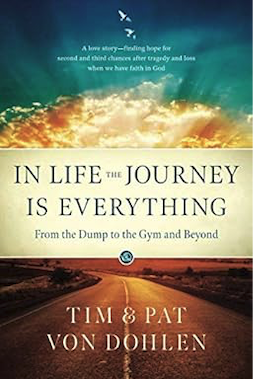
My wife Patricia and I encourage you to get your copy of our book, In Life The Journey Is Everything from Amazon where all proceeds go to the St. John Paul II Life Center.
Special pricing is available for anyone ordering six or more copies; contact me directly (tim@tvdg.com).
RELATED RESOURCES:
- In Life The Journey Is Everything , by Tim and Pat Von Dohlen — a truly inspiring read!!-Catholic Business Journal
View Articles If you’ve met Tim, you know that his life was shaped by good values that were imparted to him by his parents and he... MORE »
You must be logged in to post a comment.